NoETL
NoETL is an automation framework for Data Mesh and MLOps orchestration.
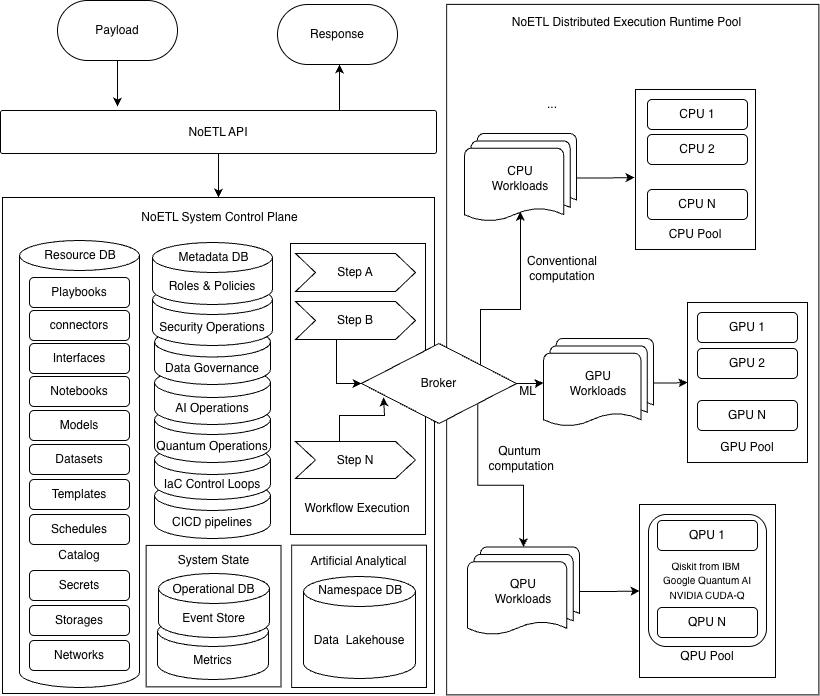
What is NoETL?
NoETL is an AI-data-driven workflow runtime designed for domain-centric data products and AI workloads:
- Data Mesh & Lakehouse - Domain teams own their pipelines while sharing the same runtime
- MLOps Orchestration - Feature engineering, model training, and online scoring
- Analytical Workloads - Risk scoring, healthcare analytics, marketing attribution
- Observability Analytics - SRE and platform team automation
Key Capabilities
| Capability | Description |
|---|---|
| Declarative DSL | YAML-based playbooks with Jinja2-compatible templating (minijinja) |
| Multi-Tool Execution | HTTP, Python, PostgreSQL, DuckDB, Snowflake, and more |
| Distributed Workers | Horizontal scaling with stateless worker pools |
| Event-Driven | All execution emits structured events for analytics |
| AI-Native | Semantic search and LLM reasoning over executions |
Quick Links
- Quick Start - Get running in minutes
- Installation - Rust CLI and Kubernetes setup
- Playbook Structure - Learn the DSL
- DSL Reference - Complete specification
- Authoring playbooks with AI agents - Point Copilot or any agent at the playbook schema, and the traps schema validation will not catch
- GKE Runbook Notes - Build, deploy, auth, execute, and validate on GKE
- A2A Agent Mesh (signal-mesh) - Tiered A2A / ReAct agent mesh over an EHDB-shaped event log
Architecture Overview
NoETL follows a server-worker architecture:
- Server: Orchestration + REST API (catalog, credentials, events)
- Workers: Stateless executors that run workflow steps
- CLI: Runs playbooks directly (locally in-process by default), and manages server/worker lifecycle and catalog operations
The same playbook runs in three deployment modes: in-process through the CLI
(noetl run -r local), as a resident single-host daemon (noetl subscribe),
or on the distributed runtime in Kubernetes. See
Deployment Modes.
Playbooks can be served to outside clients over MCP and as agents, and separate NoETL instances can register, discover each other and hand off work. See Interop: MCP, Agents and Instances.
For detailed architecture, see Architecture.
Design Philosophy
NoETL takes inspiration from:
- Erlang - Everything is a process; isolate and supervise failures
- Rust - Explicit ownership of data and context
- Petri Nets - Explicit state transitions and token-based parallelism
- Apache Arrow - Zero-copy data interchange
Learn more in Design Philosophy.