Message Learning & Event-Driven Orchestration
NoETL implements a message learning architecture for continuous workflow optimization through event-driven feedback loops.
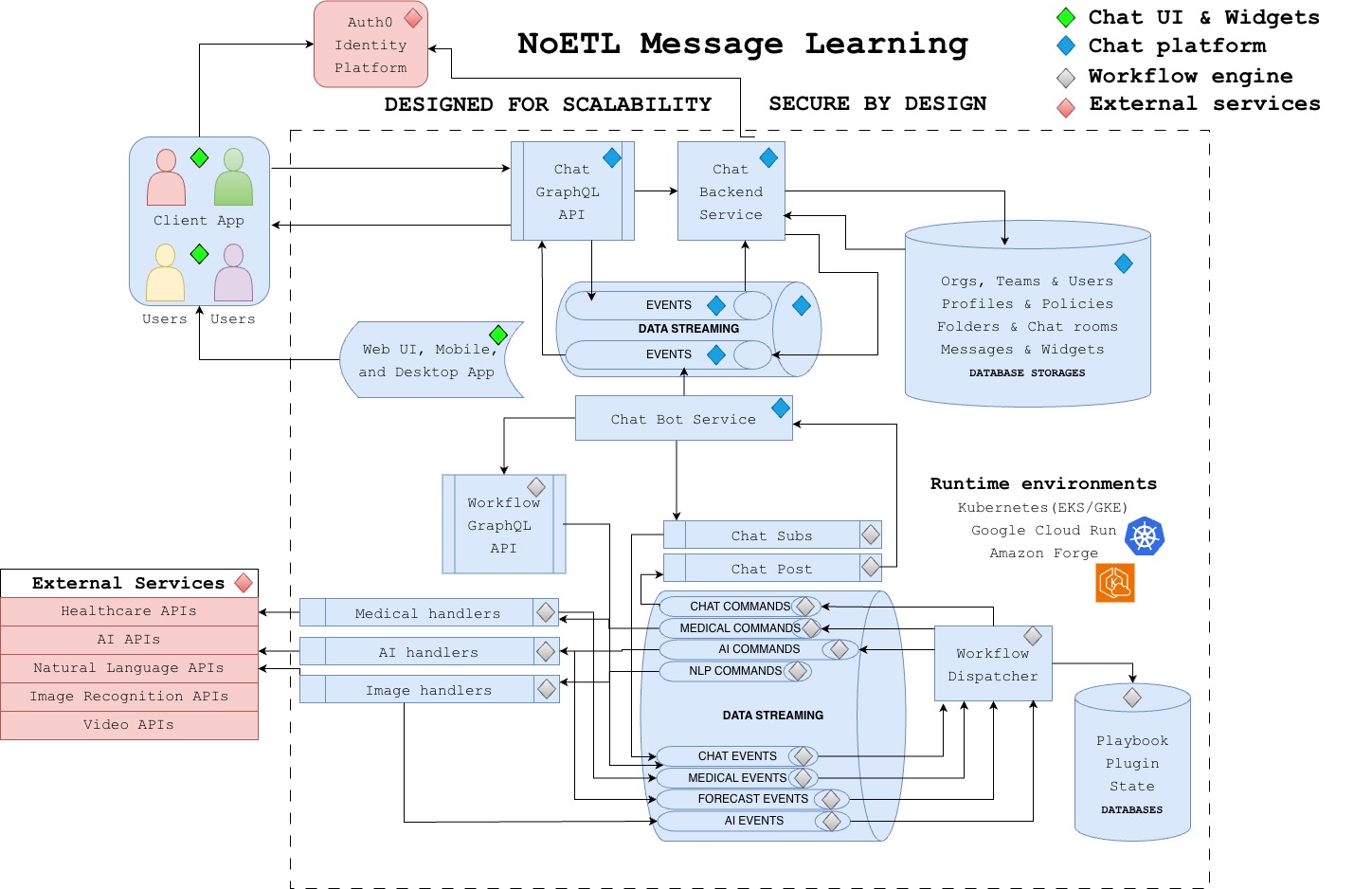
Event Learning Concept
Event learning enables NoETL workflows to improve over time by capturing execution patterns, outcomes, and human decisions as structured events:
- Execution Events: Every workflow step emits start/finish/error events with timing and metadata
- Decision Events: Human approvals, overrides, and interventions captured as first-class events
- Feedback Loops: Downstream system responses fed back into workflow optimization
- Pattern Recognition: AI models analyze event streams to detect anomalies and suggest improvements
Message Learning Architecture
The message learning system operates as a control loop:
- Business Task Execution: Workflows process domain-specific tasks (data pipelines, ML training, API integrations)
- Event Capture: All execution state persisted to event log with full context
- Human-in-the-Loop: Decision points where domain experts review, approve, or override automated actions
- Learning Layer: Vector embeddings and semantic search enable AI assistants to:
- Suggest workflow optimizations based on past executions
- Recommend error recovery strategies from similar failures
- Auto-tune retry policies and resource allocation
- Generate new playbooks from natural language descriptions
Control Loop Components
1. Event Bus (PostgreSQL + ClickHouse)
All workflow execution state stored as immutable events:
SELECT execution_id, step_name, status, duration_ms, error_message
FROM noetl.event
WHERE playbook_path = 'data/ingestion/daily_load'
ORDER BY created_at DESC;
Events exported to ClickHouse for analytics and AI agent access via MCP server. See Observability Services for more details.
2. Human Decision Points
Workflows can pause for human review using conditional routing:
workflow:
  - step: validate_data_quality
    tool:
      kind: python
      code: |
        # Check data quality metrics
        result = {"quality_score": 0.85, "anomalies": 12}
    next:
      - when: "{{ validate_data_quality.quality_score < 0.9 }}"
        then:
          - step: await_human_approval  # Pause for review
        args:
          issue: "Data quality below threshold"

  - step: await_human_approval
    tool:
      kind: http
      method: POST
      url: "{{ workflow_approval_service }}/requests"
    # Execution pauses until approval received via callback
3. Feedback Collection
Capture outcomes and human decisions:
- step: record_decision
  tool:
    kind: postgres
    table: execution_decisions
    data:
      execution_id: "{{ execution_id }}"
      decision_maker: "{{ current_user }}"
      action: "{{ vars.approval_action }}"
      reasoning: "{{ vars.approval_comment }}"
      timestamp: "{{ now() }}"
4. AI-Assisted Optimization
Vector search over execution history enables:
- Semantic Playbook Search: Find similar workflows by natural language description
- Error Resolution: Retrieve past solutions for similar failures
- Parameter Tuning: Recommend optimal retry policies, timeouts, resource limits
- Auto-Generation: Create new playbooks from examples and documentation
Example query via ClickHouse MCP:
# Find similar failed executions for error recovery
similar_failures = clickhouse_mcp.query(
    query="""
    SELECT execution_id, playbook_path, error_message, resolution
    FROM observability.noetl_events
    WHERE status = 'failed'
      AND similarity(error_embedding, %(current_error_embedding)s) > 0.8
    ORDER BY created_at DESC
    LIMIT 5
    """,
    params={"current_error_embedding": embed(current_error)}
)
Business Task Automation Patterns
1. Data Pipeline Orchestration
ETL/ELT workflows with quality gates:
- Ingest data from sources
- Transform and validate
- Human review for anomalies
- Load to warehouse
- Capture feedback for future anomaly detection
2. MLOps Lifecycle
Model training with experiment tracking:
- Feature engineering
- Model training with hyperparameter tuning
- Validation against production baselines
- Human approval for deployment
- A/B test results fed back for next iteration
3. API Integration Workflows
Multi-step API orchestration with retry logic:
- Fetch data from external APIs
- Transform and enrich
- Conditional routing based on response patterns
- Adaptive retry strategies learned from past failures
Benefits of Message Learning
- Continuous Improvement: Workflows get smarter over time without code changes
- Domain Knowledge Capture: Human decisions preserved as structured data
- Explainability: Full audit trail of automated and manual actions
- AI-Native: Semantic search and LLM reasoning natively integrated
- Resilience: Learn from failures to prevent future issues
Observability Stack Integration
Message learning leverages NoETL's observability stack:
- ClickHouse: Event storage and analytics queries
- Qdrant: Vector embeddings for semantic search
- NATS: Real-time event streaming for instant feedback
- VictoriaMetrics: Time-series metrics for performance analysis
- Grafana: Dashboard visualization of execution patterns
See Observability Services for complete integration details.
Next Steps
- Playbook Structure - Learn the DSL syntax
- Observability - Analytics stack setup
- AI-Native Features - Semantic search capabilities